
You are thinking of selling at Fairs, Fetes or Markets, and wondering about the local school Christmas fair that is coming up – and suddenly there are so many things that flood into your mind. ‘what if nobody likes my creations?’, ‘what if I don’t sell anything?’, ‘I don’t think I can do this’.
Right, STOP those thoughts right now because you CAN DO THIS!
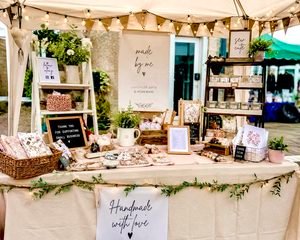
I know because that is exactly how I felt when I first started – and believe me, once you are there and setting your table up, with maybe a slight glance around at others as you do so, you will see that your creations are just as good as others, maybe even better !
And when that first customer approaches your table and you engage in conversation about your creations, all those nerves and concerns you had will vanish. Before you know it, the fair will be drawing to a close and it will be time to pack up and count your takings.
Now, being your first sale ever, hopefully you have managed to cover the costs of your table with your takings. If you haven’t, don’t despair – look at it as an experience and think positively. Was there something you could have done differently that may have increased your takings? I will give you some tips later that may help.
Booking Venue and Regulations
Some venues do require sellers to have a Public Liability Insurance in place at time of booking. This is relatively easy to do through an insurance broker and is not usually very expensive – it’s just something you have to add to your costs.
School fetes, craft fairs and markets often advertise on social media platforms, with details of who you need to contact to book your table or pitch. When you make contact, that’s when you find out cost of table or pitch, and possibly where your pitch will be positioned – positioning can be important, as I will go into in more detail later.
You will also get information regarding what time you need to arrive and how much time you will have to set up before the ‘buyers’ arrive.
Are chairs allocated per table ? This is another question to ask at this point of contact. Believe me, you will not want to be standing all day! And if chairs are provided, its one more thing you don’t need to bring with you.
Choosing Stock to Take
What do you take with you? Well I see it as ‘people cannot buy what they cannot see’, so I take as much as I possibly can.
You can always put excess stock in a box under your table, and as you sell something from the top of table you can fill the space with another item.
It’s better than standing there with a half empty table thinking ‘I could have sold a lot more if only I had brought those with me!’
Pricing and Tags
Obviously, make sure you have prices clearly displayed on your creations. This could be with a small tag on each item or a price label displayed next to a group of similar items.
Don’t rely on customers asking you how much something costs. Some people will ask, but others may simply walk away if they cannot see a price.
Also, if you are busy talking to one customer – and believe me, you will sometimes get a particularly chatty one! – other people can still browse your table and see your prices without having to interrupt.
Make sure you have worked out your prices beforehand, taking into account the cost of your materials and the time it has taken you to make each item. You don’t want to be trying to work all this out on the day.

Table Presentation
This is important because you want your table to look inviting and interesting. You don’t want to just lay everything flat on the table.
I always use a tablecloth that is large enough to cover the whole table and hang down at the front. This not only looks much nicer, but also hides all those boxes and bags you have stored underneath!
Try to create different heights when displaying your creations. You don’t necessarily need to buy expensive display stands. I have used boxes underneath the tablecloth to create raised areas, which works really well.
Think about colours too. Choose a tablecloth that compliments your creations rather than one that competes with them. You want your creations to be the stars of the show.
Lighting can also make a big difference, particularly if you are indoors or in a darker area of the venue. Small battery-operated lights can help brighten your display without needing access to an electrical socket.
There are Affiliate links in this post – as an Amazon Associate I may earn a small commission on qualifying purchases.
And don’t forget your business name. Have it clearly displayed at the front of your table so people can see who you are. If you have business cards, you can also leave some on the table for people to take away with them.
Arrange your items so that customers can see them and pick up for a closer look. As things sell, move your display around or bring some of that extra stock from underneath the table to fill empty spaces.
And remember, your display doesn’t have to be perfect. You will soon discover what works for you, and every fair will give you new ideas for the next one.
Float Money
Even though many people now pay by card, you should still have some cash available as a float for customers who want to pay with cash.
Make sure you have a good selection of coins and smaller notes so you can give change easily. The last thing you want is for your first customer to hand you a £20 note for a £5 item and you have no change!
Keep your float somewhere safe and easily accessible to you, but not somewhere that is easily accessible to everyone else. I personally like to wear a market trader money belt like this one – that way I have my money with me at all times, there is also pockets for my phone, card reader and note book.
It’s also a good idea to make a note of how much money you started with in your float. That way , at the end of the day you can seperate your original float from your actual cash takings.
Card Payment
These days, more and more people prefer to pay by card, so it is well worth considering havng a card reader with you.
There are several different card payment systems available, so have a look around and find one that suits you. Remember there may be charges involved with taking card payments, so take these into account when working out your costs.
If you are using a card reader, make sure it is fully charged before you leave home and that you know how to use it. You don’t want to be trying to work it out for the first time while a customer stands in front of you waiting to pay!
It’s also worth checking what sort of internet or mobile connection you will have at the venue, as some card payment systems may need a connection to work.
And don’t forget your phone – make sure that is fully charged too, particularly if your card reader connects to it.
How you present yourself
How you present yourself is just as important as how you present your table. Smile, look approachable and acknowledge people when they stop and look at your creations.
Try not to sit there looking at your phone, even during quieter periods. If someone approaches your table while your engrossed in your phone, they may feel as though they are interuppting you and simply walk away.
On the other hand, don’t pounce on them either! Give people a chance to browse. A friendly ‘Hello’ or ‘Good morning’ is often enough to start with.
If they pick something up or show particulat interest in one of your creations, that can be a natural opportunity to start a conversation. You might tell them a little about how you made it, what materials you used or the inspiration behind it.
Rember, you know your creations better than anyone else, so don’t be afraid to talk about them. Your entusiasm can be infectious-but give the customer space to enjoy looking too.
Most importantly, just be yourself. You don’t need to become a salesperson; you are simply the person who created all those lovely things sitting on the table in front of them.
Things People Forget to Take – When Selling at Fairs, Fetes or Markets
There is nothing worse than arriving at your venue, starting to set up and suddenly realising you have forgotten something important! So, make yourself a checklist beforehand.
Here are a few things that are easily forgotten:
- Bags or packaging for customers purchases.
- Business Cards or leaflets with your website and social media details.
- Pens and a notebook very, very useful.
- Scissors and sticky tape for those little emergencies.
- Spare price tags or labels in case you need to change or replace one.
- Card Reader and Phone both fully charged
- Your cash float and somewhere secure to keep it.
- Water and something to eat particularly if you are going to be there for several hours.
- Any medication or personal items you may need during the day.
Your Position at the Venue
When you first start selling at fairs, fetes or markets, you may not get much choice about where your table or pitch is positioned. However, if you are given a choice, it is worth giving position some thought.
Obviously, being somewhere with plenty of people passing by is good, but there can be advantages to other certain postions too.
For example if there is a café or refreshment area at the venue, being positioned nearby can work really well. People sitting down with a cup of tea and a slice of cake have time to look around, and your display may catch their eye. They may decide to come over and take a closer look once they have finished.
Try to avoid being tucked away in a dark corner if you have a choice, although good lighting on your table can certainly help if that is where you end up.
And remember, you never know who may be looking at your work. At one event, I was displaying some of my paintings and a restaurant owner saw them. He was opening a new restaurant and invited me to display my paintings there.
So even if somebody stops to admire your work but doesn’t buy anythingthat day, it does n’t necessarily mean nothing will come from it. Selling at fairs and markets can sometimes lead to opportunities you never expected.
During Quiet Periods
Don’t just assume the day is a failure, use that time to rearrange your table, restock and fill any gaps, and observe what items people are picking up and looking at. Take photos of your table to post on social media. If it’s still early in the day, that may even encourage more people to come along.
Don’t Pack Away Too Early
I see this happen at fairs, at it annoys me a little. Not only is it rather rude to the organisers of the event, who have given clear start and finish times, but it can also have a negative effect on buyers who are still there.
And wouldn’t you be upset if you had just packed away when a sudden rush of potential customers arrived, and there you were with an empty table? opportunity missed!
After the Event
You can count your takings, Take away your original float and deduct your table costs to get a clearer idea of what you actually made from the event.
Take note of what items sold, which ones didn’t do so well, and learn from it rather than judging the success of the event purely on how much money you made that day.
Remember, what does not go well at one fair can go down a storm at another venue!
Sometimes you can do everything right and there simply aren’t enough buyers. There could be various reasons- it could be the weather, there maybe other events going on in the same area on the same day.
Or perhaps the event its self wasn’t advertised well enough. Whatever the reason it does not mean your creations are not good enough.
Finally – Enjoy the Experience
Yes – your first fair can be very nerve racking., I don’t mind saying I was terrified! As I nervously set my items out, I kept looking over my shoulder at the other sellers to see how they were doing theirs.
But it wasn’t long before I got talking to the other stall holders and started to relax, I realised I was among a friendly bunch of people who were all there for the same reason as me.
We all have had our very first experience of selling at fairs, fetes or markets at some point, and you know what? we all survived, and some of us go back and do more – so it can’t be that bad.
I do hope you have found this helpful and it gives you the confidence and motivation to go ahead and register to start selling at fairs, fetes or markets.
You can see more posts I have written right here
thanks all good tips, I’ve done lots of stalls,created beautiful jewellery,resins sewn craft, I still do this, but I’ve realised that children don’t call by therefore parents walk by, so as suggested before, I now sell childrens toys, this saved my bacon last one I did, so guess what I’ve been shopping on market place and always buying more, it’s a great way for children to bring their mums to your table.
thanks Becky Casey
Thank you so much, Becky. I completely agree – anything that encourages children to stop and look can bring the parents over too! It sounds as though you’ve had plenty of experience doing stalls yourself. Thanks for taking the time to comment.😊 Maz